Posts

How many things do you have?

Image
The next question might be: And how many do you really need? Very few, I would say. The problem is that we do not think about their purpose or the joy about having less stuff. We are educated to work more, to get more money, to buy more stuff without ever thinking what make us happy. The Minimalists leave their message: love people and use things because the opposite never works !

Destructive and scary fish

Quando temos um artigo do MEC como este no jornal Publico, a falar de uma forma tão simples de um assunto tão flagrante, pouco fica por dizer sobre os hábitos de consumo de pescado em Portugal: Nos restaurantes e nas praças grassa um peixe igualmente destrutivo e assustador: a perca do Nilo. Apesar de ser um peixe de rio, criado em condições deploráveis, é bastante mais caro do que muitos peixes selvagens do mar. Há, por exemplo, a sarda, o sarrajão, a solha, a safia e o safio, mencionando apenas os mais apetitosos com nomes a começar por S. Porquê? Não faço ideia. Não compreendo como é que um país com tanto peixe do mar relativamente barato gosta de comer um peixe de rio que sai tão caro. Será preguiça? Será ignorância? Eu também não compreendo mas acredito que o preço baixo é um factor atractivo e sim, pode ser ignorância porque a que a maioria das pessoas não deve saber o que está a comprar. É difícil de compreender como é que a  Perca do Nilo , um peixe de água doce que...

Mr Smashing Hit

Image
Destroying the deep sea to get metals for our throw-away mobile phones and other e-devices? Seas At Risk thinks it is better to step up efforts on the circular economy – make devices repairable, re-usable, recyclable. Use mineral resources more efficiently and keep them in the economy loop instead of wasting them. Buy less, plan more and live simple.
Image
I found my interest in the ocean with you You taught me all you knew of the deepest blue It's all within us you said to me As we walked on black sands And you melted as an iceberg in my hands There's an ocean in your eyes I can feel the tidal waves Crashing down Beneath the skin Reynir | André Barros

State of World Fisheries and Aquaculture (SOFIA)

Image
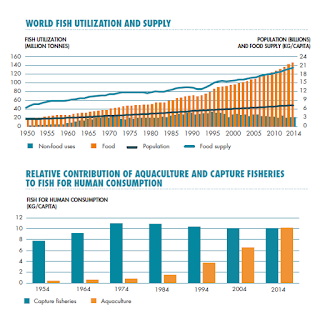
Every year FAO publishes the world fisheries and aquaculture data submitted by member states. It is a useful source to analyse globally the state of the oceans and to understand trends regarding the seafood production and consumption. One of the key messages from the publication SOFIA 2016 was that  world aquaculture production continues to grow and now provides half of all fish for human consumption. Source: SOFIA 2016 Pauly and Zeller (2017) just published a paper criticising FAO for reporting inaccurate data and giving wrong impressions about the seafood production overview. Here there are some of the statements that the argue against: 1. the catch of world marine fisheries is not "stable" We do not believe that this perceived ‘stability’ in marine fisheries catches is the case. One reason is that the catch reconstructions that have been conducted through the Sea Around Us over the last decade for all countries of the world and which will be discussed fur...

Keystone dialogues

Image
As in other business areas, a few companies in the world control almost the overall seafood market. These key companies, responsible for most of the seafood production, are committing to move further to sustainability with science support. If they do, others might follow. This is an interesting initiative since apart from the scientific background it is based in "dialogues", "communication" and "connecting" different parts of the issue. The seafood production is a business above all the resources or environmental constrains and if we want to improve sustainable measures, it is not enough to use only science based policies or consumers' advice. We need to connect the parts. The word “keystone actor” is an analogy with the “keystone species” concept in ecology, developed by Professor Robert T. Paine. A scientific paper published in 2015 by Österblom, Jouffray, Folke et al. illustrates that the largest companies in a given industry can opera...

Feel the beat, try to move the feet and eat eet eet

Image
It's like forgetting the words to your favorite song You can't believe it You were always singing along It was so easy and the words so sweet You can't remember You try to feel the beat Eet, eet, eet, eet Eet, eet, eet, eet You spent half of your life trying to fall behind You're using your headphones to drown out your mind It was so easy, and the words so sweet You can't remember You try to move your feet Eet, eet, eet, eet Eet, eet, eet, eet Someone's deciding whether or not to steal He opens the window just to feel the chill He hears that outside a small boy just starting to cry 'Cause it's his turn but his brother won't let him try It's like forgetting the words to your favorite song You can't believe it You were always singing along It was so easy and the words so sweet You can't remember You try to move your feet It was so easy and the words so sweet You can't remember, you try to feel the beat

The Portuguese fish

Image
after football, Portuguese fish could be a national pride...maybe one day!

We should eat less meat

Image
this is a campaign to help consumers from a Swedish supermarket! if retailers care, we can make it, because as they say  we need to help each other .

Why don't we do the right thing in relation to climate change?

Image

Tomorrow will be a better day

Image
tomorrow will be a better day...this is more or less what Tomorrow  movie tells us. I enjoyed the positive approach of the movie that is about sustainable way of living but also the overall perspective about how to change habits and political models which our society is based in. I thought it was very interesting to learn with the movie  Where Does Money Come From?  because it is amazingly simple and terrifying at the same time. Money is created by banks, private companies: Physical cash accounts for less than 3 per cent of the total stock of money in the economy. Commercial bank money – credit and coexistent deposits – makes up the remaining 97 per cent of the money supply.  There are several conflicting ways of describing what banks do.  The simplest version is that banks take in money from savers, and lend this money out to borrowers. This is not at all how the process works.  Banks do not need to wait for a customer to deposit money before t...

Cucurrucucú

Image

the way we love

Image
we have to reinvite love,  says Alain de Botton. romanticism made us think that all of us have a specific soul mate to find but maybe we just follow the love conception from our society. he gives some tips to know when someone is ready for love: be generous in the interpretation of the behaviour of other person use humour to deal with situations understand your are crazy understand the other person is crazy the communication should be in a basic level there will be a lot of practical work to make it happen one will be unhappy a great amount of the time pessimism is future of love! I wonder if it turns out that romanticism is actually real and that love is the meaning of life. should we give up to find it?

Pet dinner with conscience

In June 2014 there were  released news from a six-month investigation about slave labour to fish prawns for supermarkets in US and UK . It was revealed that large numbers of men are being bought and sold like animals and held against their will on fishing boats off Thailand to work in the production of prawns (commonly called shrimp in the US) sold in leading supermarkets around the world. The news raise the discussion about seafood traceability and retailers as Carrefour took action in dissociating their supermarkets from a human exploitation and lack of human rights production source. At this time the discussion was about prawns, an expensive and high value seafood product, but more is needed to discuss when it comes to Thai seafood industry for low quality standard as pet food: The USA is the biggest customer of Thai fish, and pet food is among the fastest growing wxports from Thailand, more than doubling since 2009 and last year totaling more than $190 milion. The a...

Blue Growth, aquaculture and mussels

Image
If you are a fish consumer, it is almost certain that you eat seafood produced in aquaculture such as salmon, sea-bream, sea-bass, turbot and mussels. On average every person in European Union (EU) consumes 5.5 kg of seafood from aquaculture production per year  [1] . Mussels are the most produced species in the EU followed by trout, salmon and oysters; but the total output of European aquaculture represents only 1.5% of the global production. Given that 57% of farmed fish consumed in the Europe is imported, the European Commission (EC) now wants to encourage the growth of aquaculture production in all member states and aquaculture appears as one of the five strategic areas in the "Blue Growth" designed by the EC, which includes also the development of coastal tourism, biotechnology, mining seabed and ocean energy  [2] . Decisions relating to aquaculture, even if they are made through the reform of the Common Fisheries Policy (CFP), unlike as it happens with fis...
Image
It is sad to assist the last days of something but even more sad when it is something big, unvaluable, timeless and with no material heritage. It is there now and will never be there again. It will change forever a river, ecosystems, vineyards, a railway, landscape, people's life! There will be no way to come back after this is done. We should enjoy the last days. Please, take action and find more about the issue  here . Moreover we should be able to decide where the energy that we pay comes from. I do not want to pay energy that comes from this dam and I do not want my taxes being used to fund the construction of a dam like this, which in the end will be used by a private company. What do you want?

We gotta be so many things but I hope love will save the day

Image
Listen as your day unfolds, challenge what the future holds Try and keep your head up to the sky Lovers, they may cause you tears Go ahead release your fears, stand up and be counted Don't be ashamed to cry You gotta be You gotta be bad, you gotta be bold, you gotta be wiser You gotta be hard, you gotta be tough, you gotta be stronger You gotta be cool, you gotta be calm, you gotta stay together All I know, all I know, love will save the day Herald what your mother said Reading the books your father read Try to solve the puzzles in your own sweet time Some may have more cash than you Others take a different view, my oh my, heh, hey You gotta be bad, you gotta be bold, you gotta be wiser You gotta be hard, you gotta be tough, you gotta be stronger You gotta be cool, you gotta be calm, you gotta stay together All I know, all I know, love will save the day Life asks no questions, it goes on without you Leaving you behind if you can't stand the pace The ...

Why we should eat less meat

If it is need to find arguments why we should eat less meat, here there are two good ones: Firstly, current rates of meat consumption in wealthy countries – particularly red meat – are unsustainable under any circumstances, and must be reduced due to the burgeoning health and environmental impacts.  Secondly, industrial feedlot production yields too many negative outcomes on too many fronts to be justifiable. These systems require large quantities of imported feed crops, thereby displacing potential food production: an area the size of France is required for the EU to import its feed requirements. Meanwhile, they depend on extensive use of antibiotics, entail major GHG emissions (both in the production area and in the shipping of inputs and outputs to far-off locations), cause localized environmental degradation due to the huge waste they produce, and often subject animals to stressful and inhumane conditions. Industrial feedlots cannot conceivably be part of the sustainable fo...

Sustainable fables storytelling

Image
I'm amazed how the speech in the first person can make the message so much easier to understand and to encourage other people to do the same. When I talk about my work during the PhD, we often end up talking about recipes. It seems silly to go from a scientific thesis, with so much data and reading put on, to such an ordinarily everydays life issue :) Buy, cook and eat...or decide and plan before each step. I think about this issue also because I usually tend to personalize the examples that I give, which can only be seen as my point of view, of course, and my generalizing conception of reality. But the point is: it makes the theory turn to real. Bea Johnson has this approach as "do it sustainable by yourself" in her life mode. Being part of an experiment about changing consumption habits is better than any graphic or numbers that one can use. She can explains everything very clear and with passion and it is an easier way to spread the message because it is shown...

aquilo que não fazemos todos os dias

...a rotina embacia-nos, torna-nos indefinidos, desfocados, fantasmas, máquinas, ao mesmo tempo que nos solidifica em estátuas de sal. A consciência da morte é o que nos desperta dessa morte em que vivemos, que nos diz o que deveríamos ter feito, o que deixámos de fazer, a morte é um despertador, um despetador que nos acorda para a inevitabilidade dos nossos erros. Morreremos em breve, temos de agir, de resistir. Não desistiremos. A solução seria termos todos uma caveira na mesinha-de-cabeceira, como fazem os monges cartuxos, para nos servir de despertador e todos os dias sabermos que temos de acordar, não para viver a rotina fatal do quotidiano, mas a vida apaixonada de alguém que ainda sabe que existem nuvens, céu e beijos. ... Porque viver não tem nada a ver com isso que as pessoas fazem todos os dias, viver é precisamente o oposto, é aquilo que não fazemos todos os dias. in Flores, Afonso Cruz