Posts

Showing posts with the label Sardinha

O peixe que comemos e o que pescamos: duas realidades num só prato

Image
definir consumo sustentável de pescado é um grande desafio para a maioria de nós. muitas são as dúvidas que se colocam, e apesar da informação que existe, é difícil criar critérios coerentes. mais aqui , no artigo da Newsletter da LPN.

How to eat sardines

Image
If you need to find the best way regarding to the environment (CO2 equivalent emissions) on how to prepare sardines, you just need to read: Environmental Life Cycle Assessment of a Canned Sardine Product from Portugal  Cheila Almeida, Sofia Vaz and Friederike Ziegler  This study aims to assess the environmental impacts of canned sardines in olive oil, by considering fishing, processing, and packaging, using life cycle assessment (LCA) methodology. The case study concerns a product of a canning factory based in Portugal and packed in aluminum cans. It is the first LCA of a processed seafood product made with the traditional canning method. The production of both cans and olive oil are the most important process in the considered impact categories. The production of olives contributes to the high environmental load of olive oil, related to cultivation and harvesting phases. The production of aluminum cans is the most significant process for all impact categories, except oz...

Portuguese sardine is with problems again

The Marine Stewardship Council (MSC) announced last August the suspension of the Portuguese sardine purse seine fishery, after Intertek Fisheries Certification (IFC) withdrew the certification following the fourth surveillance audit report on the fishery.  Sardine harvested after 14 August may no longer be identified or sold as MSC certified and cannot carry the blue MSC sustainable fishery ecolabel.  According to the surveillance report, the fishery no longer complies with the minimum requirements of Principle 1 of the MSC standard - sustainable fish stocks. This principle demands that the fishing activity must be at a level which is sustainable for the fish population.  This is the second time the fishery has failed an annual surveillance audit since it was first certified. In both cases the suspension was due to low Iberian sardine stock levels. Despite efforts made by the fishery and the Portuguese institutions in favour of sustainable management, stocks are no...

And if there are no sardines?

Image
People can eat sardines all the time in Portugal! They are better in the start of the summer, when there is the habit to grill them. But they can definitely be good in  other seasons and prepared in different ways .  There is another good fish similar to sardines: the Atlantic chub-mackerel . This fish is not so common among Portuguese habits. Why? In my opinion it is only about food habits and knowledge on how to cook it. It is the same reason why people in Portugal eat so much bacalhau:   because they had learned since long time ago how to cook it and then it is rooted in the Portuguese habits. This fish is a "brother" of the Atlantic mackerel , which is a very popular fish in Scandinavia, usually eaten smoked or canned in tomato.  But in Algarve almost half of the catch of this specie is wasted. The same happens in other parts of Portugal. The problem is that Atlantic chub-mackerel is catched together with sardine,...
Image
When I talked to fisherman from the sardine fishery, sometimes they mention their preoccupation about the sardine price in relation to chicken. They said that chicken was getting continuously a lower price at the stores, and that it was difficult to compete with it and make people to buy sardines. But... Can we compare both productions systems? Moreover, Can we compare the quality of protein and animal welfare of both foods? Here it is a very interesting  study  about Life Cycle Assessment of broiler chicken production in Portugal. It is based in data from Portugal and applied to the Portuguese food consumption. In Portugal, 75% of chicken meat consumed is  broiler chicken  and it is the most consumed meat in the country.  When comparing the global warming potential (GWP) of chicken production systems with those of pork and beef production systems, considering a functional unit based on the same protein supply (168.4 g), the production of broiler ...

Food from the sea

Image
Sardines were  here .

The empty feeling of no conclusions

Image
When I started the PhD, the cod stocks were in very bad shape. On the opposite, sardine is a fish from low level of the marine food web; catch with purse-seining, a fishery with relatively low environmental impacts, and had greater potential of consumption in Portugal, since Portuguese love more sardines than any other people. Because Portuguese eat so much cod, it would be great if they would eat more sardine (or other small pelagic fish) instead. It turns out that after some years of trying to have something interesting to say in a PhD thesis... The cod is not so bad because some stocks (not all!) as for example the Norwegian, recovered and are now certified by MSC . Plus this year the North Sea cod stock seems that had finally recovered . And Portuguese sardine stock (Iberian stock) had problems, with consequent s uspension of the MSC certification in 2012. Now more and more evidences show that it is a threat to marine life the depletion of sardine stocks, with importan...

No sardine, no fun

Image
Has in Portugal, moreover in the Atlantic, the sardine is an important fish in the Pacific. But not only for people. It is an important food for other marine animals, as birds and mammals. There is not enough information why, but the sardine stock seems to be declining in the California coast. As it happens to other top predators as tuna, that have been intensively harvested, the sardine fishery can also have irremediable consequences for the marine ecosystem. Sardine is in a low level of the marine trophic web but they have an important role for other predators. If we fish too much, there is less sardine to feed other animals and it is more difficult to recover. If we look back, we can learn from the past. Without fish, there is no fishery, no food...and in the end no sea life. The decline has prompted steep cuts in the amount fishermen are allowed to catch, and scientists say the effects are probably radiating throughout the ecosystem, starving brown pelicans, sea lions and...

Sardine Life Cycle Assessment: done!

Environmental assessment of sardine (Sardina pilchardus) purse seine fishery in Portugal with LCA methodology including biological impact categories The assessment of the Portuguese purse seine fishery resulted in no difference regarding fuel use between large and small vessels, but differences were found between years.  The stock has declined, and it has produced below maximum sustainable yield.  By-catch and discard data were missing but may be substantial.  Even being difficult to quantify, fishery impact categories complement the environmental results with biological information and precaution is need in relation to the stock management.  The sardine carbon footprint from Portuguese purse seine was lower than that of other commercial species reported in. Yupiii. I´m very happy. Thank you all that help to make this study possible. Especially to SV and FZ for their endless support, and fishermen and colleagues for their enormous gratitude and inspiration...

Shrimp eat fish

Image
Shrimp that eats fish is a problem. Especially if that fish can be eaten by people. If you wonder Where Do All the Little Fish Go? ...forage fish or ‘small pelagics’, make up a huge part of the global catch.  All those anchovy, sardines, menhaden, herring, and other small shoaling fish can add up to roughly a third of all the fish landed, and the majority are not destined for direct human consumption.

The perfect protein

Image
​ In The Perfect Protein, Andy Sharpless shows how seafood is the healthiest, cheapest, most environmentally friendly source of animal protein on Earth.  Sharpless contends that we must save the world’s seafood not only to protect marine life and biodiversity but also to stave off the coming humanitarian crisis.  With Earth’s human population expected to reach 9 billion by 2050—adding the equivalent of two Chinas to current numbers—we need wild fish more than ever to feed us (especially the nearly 1 billion of the world’s poorest people who rely on seafood as their main source of animal protein).  The bad news is that wild fish populations are in decline because of overfishing, destruction of habitat, and bycatch.  We are grinding up small “reduction” fish such as anchovies, mackerel, and sardines into feed for salmon and other farmed animals even though these overlooked fish are delicious and packed with health-boosting omega-3 fatty acids—and could feed mi...

Portuguese love fish

De acordo com esta especialista na área alimentar, não há necessidade de introduzir o peixe na nossa alimentação, porque "ele está lá já".  Aliás, faz questão de frisar, "os portugueses têm uma cultura de ingestão de peixe superior a qualquer outro país da Europa".  Está portanto provado que "nós gostamos de peixe" e, por isso, só temos de escolher os "mais certos em termos de saúde".  E os três exemplos atrás citado reúnem várias qualidades: são ricos em ómega 3, têm pouco mercúrio e, além disso, são baratos e permitem ser cozinhados de diversas formas. Very wise to hear a nutritionist saying that it is not necessary to promote more fish in the Portuguese food habits. It is already there and it is enough. The only advice is how to choose the best fish. Who are they? ...sardine, horse mackerel and chub mackerel. They are small pelagic fish, rich in omega 3, with low levels of mercury, and cheap! Good for your health, for the environm...

Sardine love story

José is gourmet. Confident, trustful and a dreamer. Knows what he wants. Does not take excuses, just do what he believes. He find pleasure in the most simple things nature can give to us: food. And he respect every single piece of food. Maria is organic. Cares about the others, the environment, the planet. Wants to make sure that the natural cycles are respected. Likes to feel colours, smells, tastes. Likes to be alive and respect every breath of air. After long time searching: Maria has found José . And they are in love! Some sardine love in Spain also!

Et voilá, le sardine!

Image
Oui, oui oiu...

Moments in a sardine life III

...in Brazilian. Portugueses garantem que têm a melhor sardinha do mundo!  Com uma viúva de pescador, o Globo Repórter vai descobrir se a sardinha portuguesa é mesmo tão especial.  A sardinha vai ser feita à moda de Nazaré. 

Conservar o que é bom

...porque o peixe é um dos últimos alimentos de produção selvagem, e uma fonte de proteína de excelente qualidade. Conserva .

Sea festivities

As festas dos Santos Populares parece que já comecaram debaixo de água. A sardinha aparece na costa por esta altura. É uma bola de peixe que vai e vem e brilha no horizonte. E os golfinhos giram à sua volta. Os pássaros também aproveitam. E o resto dos peixes parece não se incomodar muito. Típico bailarico! O Mar em Sagres. Imagens lindas do Sul de Portugal.

Sardinha linda!

Image
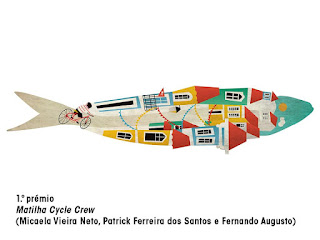
Combinacão perfeita:  sardinha, Lisboa e bicicleta. Sustentável!? As Festas de Lisboa já elegeram as  sardinhas  deste ano. Este foi a sardinha vencedora do  prémio do júri .

Fábulas em conserva

Image
In the North of Portugal there is light and life coming from the sea. God it´s always there... ...and the sardines are blessed.  Cans of love and kindness for all of you.

Moments in a sardine life II

Image