Posts

Showing posts with the label Comunicação de ciência

Mr Smashing Hit

Image
Destroying the deep sea to get metals for our throw-away mobile phones and other e-devices? Seas At Risk thinks it is better to step up efforts on the circular economy – make devices repairable, re-usable, recyclable. Use mineral resources more efficiently and keep them in the economy loop instead of wasting them. Buy less, plan more and live simple.

Sustainable fables storytelling

Image
I'm amazed how the speech in the first person can make the message so much easier to understand and to encourage other people to do the same. When I talk about my work during the PhD, we often end up talking about recipes. It seems silly to go from a scientific thesis, with so much data and reading put on, to such an ordinarily everydays life issue :) Buy, cook and eat...or decide and plan before each step. I think about this issue also because I usually tend to personalize the examples that I give, which can only be seen as my point of view, of course, and my generalizing conception of reality. But the point is: it makes the theory turn to real. Bea Johnson has this approach as "do it sustainable by yourself" in her life mode. Being part of an experiment about changing consumption habits is better than any graphic or numbers that one can use. She can explains everything very clear and with passion and it is an easier way to spread the message because it is shown...

Dump fish, buy trash

A Picture is Worth...Surfriders' Catch of the Day .

Taste the waste of water

Image

Entre o céu e as marés

A beautiful  documentary  about the beautiful Sado estuary. A major wetland of Portugal. Separated from the ocean by extensive dunes from the peninsula of Tróia, the estuary provides exceptional conditions for wildlife, especially aquatic birds. ...I wish I could also fly back home, and reach my fellows in the wildlife, between the sky and the ocean. But it's not yet my migration season. Soon it will come. I just need to find my way and follow the sun light, the stars and the coastline.

Seeds of Hope

Blue planet

Image
Votação online para o concurso nacional da «Rio+20 Global Youth Contest». A canção "Meu Planeta Azul" está na 1ª posição!!! Vooooota !

Nitrogen footprint

Although nitrogen occurs naturally and is essential for life, human activities are releasing excessive, polluting amounts into the environment.  The largest sources of nitrogen pollution come from food production and the burning of fossil fuels.  For example, artificial nitrogen fertilisers are used to improve food yields, but overuse of fertilisers results in surplus nitrogen that contaminates the environment.  Nitrogen pollution affects the health of people and ecosystems.  It disrupts the natural nitrogen cycle, damages air and water quality and contributes to the formation of smog, acid rain, ozone depletion in the upper atmosphere and eutrophication of coastal waters.  One form of nitrogen, nitrous oxide, is a potent greenhouse gas.  The N-Calculator can help people make changes to their lifestyle to reduce their nitrogen footprint.  The biggest changes are related to diet.  For example, eating less red me...

Pegada de carbono dos alimentos

A produção de alimentos tem um custo ambiental que cada vez mais se tenta quantificar. E é preciso comunicar essa informação aos consumidores, para que possam fazer escolhas mais informadas. Uma das soluções seria classificar os alimentos com uma escala, tal como acontece no consumo energético dos electrodomésticos. Mas qual será a melhor forma de passar essa informação? A maioria das pessoas não sabe o que é o Carbono. Não sabe como isso se relaciona isso com o ambiente. E sem valores de referência, é difícil de saber o que será uma quantidade aceitável para determinado produto. É uma chatice quando se trata de simplificar a informação para o público em geral: dá trabalho e é preciso ser pragmático. Coisa que os cientistas não têm tempo, os políticos só fazem se virem algum retorno e as empresas só fazem se forem obrigadas. Carbon Labeling from Creative Concern on Vimeo . Recentemente saiu a notícia que o supermercado que tinha iniciado a etiquetagem de  Carbon Foot P...

Seafood footprint

Image
The footprints of human fishermen now cover much more of the world's oceans than half a century ago. . .. The idea is to calculate the proportion of primary production - all the chemical energy stored up in living things as a result of photosynthesis - that goes to meeting human needs.  The higher up the food chain you go to find the fish of interest, the more primary productivity you're using. The ones we tend to like eating best, be it tuna, cod or salmon, live at or near the top.   See it here . It shows that European vessels are now traveling to the furthest corners of the world to exploit fish stocks. Declining domestic catches and efforts to reduce the number of vessels fishing in European waters have resulted in much of the European tuna and other pelagic fleets concentrating their fishing efforts overseas. ... According to the EU, in 2008 the EU external fleet comprised of 718 vessels, which represents 25% of the EU fleet in terms of gross tonnage.  ...

Senhores consumidores...

Image
...por favor, exijam compreender! Como cidadãos devemos ser esclarecidos, compreender os direitos, mas também as obrigações. Cumprir é um benefício para a sociedade a que pertencemos. Ou, indo um bocadinho mais longe, para o ecossistema a que pertencemos. Será um  Problema de Expressão  ou tão simples como escrever para a nossa avó?

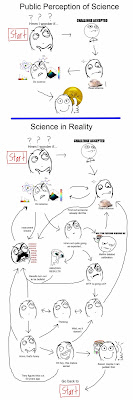
Science in reality

Image
The thinking phase seems to be multiplied by 3! Do a PhD student need 3 brains? Daqui

Why Researchers Should Blog

Image
Às vezes penso no tempo que dedico a este blog e a escrever post's. Sinto que por vezes que estou a perder tempo, a divagar. É sempre tempo que deveria estar a fazer outras coisas. Uma vez a M.A. disse-me, enquanto avaliava o meu trabalho de primeiro ano como estudante de doutoramento, que devia acrescentar como um dos resultados o meu blog. Fiquei a pensar nisso e algumas ideias que este artigo expõe são interessantes para analisar a importância de um blog na investigação. E por isso pensei também no propósito deste blog. “Publish or perish”: Academia has its own jungle law. To thrive (or even to survive, it feels like occasionally) one needs to produce texts and in this case I mean specifically texts as words (images, videos, audio presentations are not yet acceptable). Articles, book chapters, monographs, conference papers, working papers, book reviews – you name them – these are the certificates of an academic’s ability to think creatively, analytically and methodically, to pr...

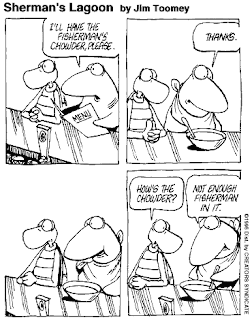
Do Scientists Have a Sense of Humor?

Eu também acho que sim!

Sherman's Lagoon

Image
Jim Toomey has been creating the daily comic strip Sherman's Lagoon, which appears in over 150 newspapers in North America. Toomey's latest book of comics (his fifteenth) is Discover Your Inner Hermit Crab .

Do the green thing

A " coisa verde " é um projecto que passa a mensagem de 7 coisas que podemos fazer para sermos mais verdes. Há 7 milhares de outras coisas, mas estas são simples e atingíveis, e podem ser adoptadas por qualquer pessoa que nunca tenha pensado no assunto. Os vídeos são muito bons: gostei do Human Heat e da comparação com os pinguins que se juntam para vencer o frio com o calor "humano" e do Plug Out com a animação em papel. O vídeo é cada vez mais um meio importante de comunicar. É simples, fácil de difundir e atractivo. O projecto português Stand by é um exemplo do que se pode fazer com uma ideia e poucos recursos. E o mais interessante será conseguir saber se no final as pessoas realmente mudam os seus hábitos. Green Thing is a not-for-profit public service that inspires people to lead a greener life. With the help of brilliant videos and inspiring stories from creative people and community members around the world, Green Thing focuses on seven things you can do -...

Porque é que o Sol brilha?

O jornalismo e a ciência em 3 minutos

Encontrei aqui este vídeo aqui que explica rápido e bem o que se passa actualmente no jornalismo de ciência. Acontece aqui como nos outros países, é um problema relacionado com a comunicação em geral. A história começa assim: 1. há cada vez mais acesso a diferentes tipos e meios de informação, 2. há por isso menos recursos, 3. assim deixa-se cair a especialização a aposta-se na generalização, 4. os jornalista não têm tempo para investigar e aprofundar os assuntos, 5. há poucas notícias boas sobre ciência... ... and in the end sabemos menos sobre o que os cientistas fazem, por isso temos menor capacidade de ter opinião sobre o que os cientistas andam a fazer, sobre o que os políticos decidem e sobre o que é decidido em função dos lobbys científicos. E que no final, ao não termos opinião, não exigimos como cidadãos, e as consequências revelam-se depois no funcionamento da nossa sociedade! THE END