Posts

Showing posts with the label Aquacultura

State of World Fisheries and Aquaculture (SOFIA)
Image
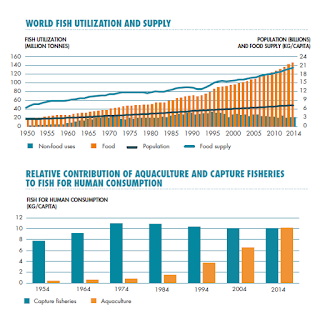
Every year FAO publishes the world fisheries and aquaculture data submitted by member states. It is a useful source to analyse globally the state of the oceans and to understand trends regarding the seafood production and consumption. One of the key messages from the publication SOFIA 2016 was that  world aquaculture production continues to grow and now provides half of all fish for human consumption. Source: SOFIA 2016 Pauly and Zeller (2017) just published a paper criticising FAO for reporting inaccurate data and giving wrong impressions about the seafood production overview. Here there are some of the statements that the argue against: 1. the catch of world marine fisheries is not "stable" We do not believe that this perceived ‘stability’ in marine fisheries catches is the case. One reason is that the catch reconstructions that have been conducted through the Sea Around Us over the last decade for all countries of the world and which will be discussed fur...

Blue Growth, aquaculture and mussels

Image
If you are a fish consumer, it is almost certain that you eat seafood produced in aquaculture such as salmon, sea-bream, sea-bass, turbot and mussels. On average every person in European Union (EU) consumes 5.5 kg of seafood from aquaculture production per year  [1] . Mussels are the most produced species in the EU followed by trout, salmon and oysters; but the total output of European aquaculture represents only 1.5% of the global production. Given that 57% of farmed fish consumed in the Europe is imported, the European Commission (EC) now wants to encourage the growth of aquaculture production in all member states and aquaculture appears as one of the five strategic areas in the "Blue Growth" designed by the EC, which includes also the development of coastal tourism, biotechnology, mining seabed and ocean energy  [2] . Decisions relating to aquaculture, even if they are made through the reform of the Common Fisheries Policy (CFP), unlike as it happens with fis...

Issues to discuss

In Portugal salmon is maybe the 3rd species among seafood most consumed . It is imported, most of it from Norway, where it comes 80% of salmon imported in EU . Moreover imports from China are on the increase, but this is actually Norwegian salmon which has been filleted and frozen in China.  The two major EU importers of Norwegian salmon are Sweden and Denmark, although they only act as hubs and actually re-export almost everything to the main EU markets for salmon (France, the United Kingdom, Germany and Poland).  This specific role of Sweden and Denmark explains why the value of intra-EU trade seems to be as big as the value of imports. Some ethical and environmental issues are important to discuss, here and there in the USA, where the GMO salmon production for food can be approved one day: GMO salmon—or franken-fish, as it is sometimes called—is an Atlantic salmon whose DNA has been re-engineered with a “growth-hormone gene construct” made from genetic material of...

When crustacean turns into fish

Image
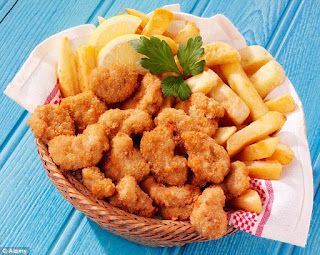
Introduced by Young’s Seafood, the UK’s leading frozen food manufacturer, after World War II as a way to use the langoustines caught by trawlermen in search of white fish, by the 1970s scampi and chips had become a favourite pub meal, served ‘in the basket’. Scampi nowdays, however, is far from simple. As part of a code of practice drawn up by the food industries in 1998, three pages of A4 are dedicated to how scampi sold in shops should be described. ... It is clear that many scampi bites sold are a long way from a fresh langoustine tail dipped in breadcrumbs and lightly fried — and nowhere is that better illustrated than in the distance travelled by some of the fish used to bulk them out.  Earlier this year, Professor Mariani Stefano, a biologist at the University of Salford, tested the DNA of samples of frozen scampi bites. Of the nine tested, two were found to contain pangasius. ... He explains: ‘It is actually incredibly bland, with almost no flavour at all. ...

O peixe que comemos e o que pescamos: duas realidades num só prato

Image
definir consumo sustentável de pescado é um grande desafio para a maioria de nós. muitas são as dúvidas que se colocam, e apesar da informação que existe, é difícil criar critérios coerentes. mais aqui , no artigo da Newsletter da LPN.

The perfect protein

Image
​ In The Perfect Protein, Andy Sharpless shows how seafood is the healthiest, cheapest, most environmentally friendly source of animal protein on Earth.  Sharpless contends that we must save the world’s seafood not only to protect marine life and biodiversity but also to stave off the coming humanitarian crisis.  With Earth’s human population expected to reach 9 billion by 2050—adding the equivalent of two Chinas to current numbers—we need wild fish more than ever to feed us (especially the nearly 1 billion of the world’s poorest people who rely on seafood as their main source of animal protein).  The bad news is that wild fish populations are in decline because of overfishing, destruction of habitat, and bycatch.  We are grinding up small “reduction” fish such as anchovies, mackerel, and sardines into feed for salmon and other farmed animals even though these overlooked fish are delicious and packed with health-boosting omega-3 fatty acids—and could feed mi...

Looking forward

Image
to do  this to be  here picture from here but first to take this If there is anything good about to don't have a consistent plan, is that you let the time decide it for you.  Good things come up whenever one imagine. Fabulas is going once again to the "cod land". And I hope to find my fish up up up there in the north.

Animais para comer

Image
Muitas vezes surge esta questão: - Então e o peixe de aquacultura...é ou não sustentável? Costumo responder ( depois de explicar que é um assunto complexo, para avisar logo que não vai sair uma resposta de sim ou não ): - Bem, depende de vários factores como, o tipo de aquacultura (intensiva ou extensiva), a espécie (carnívora ou herbívora), o local de produção (países com diferente regulamentação em termos ambientais e do bem estar animal). Mas se comparamos com a carne, frango ou porco...então eu prefiro escolher o salmão de aquacultura: é melhor em termos ambientais (maior eficiência na conversão da ração por serem animais de sangue frio e ocuparem uma área tridimensional na água), em termos de bem estar animal (a maioria dos frangos que comemos são muito infelizes durante as suas vidas nos aviários), em termos nutritivos, e comer peixe é tão bom! Na abertura do World Fisheries Congress, Ray Hilborn, que defende que a sobre-exploracão dos re...

Hen of the seas

Image
Infectious Salmon Anemia ( ISA ) is suspected at one farming site in Shelborne Nova Scotia. The area is under quarantine and the ISA report needs to be confirmed after lab tests.  Infectious Salmon Anemia (ISA) is a virus that is highly contagious in the marine environment, spread through the water between Atlantic salmon within a grow-out site, and carried by the water from one site to another ISA is highly lethal to Atlantic salmon, but does not harm humans, according to all sources.  It is present naturally in Norway and on the east coast of Canada, and has a distinct European strain and a distinct North American strain.  ISA was only discovered in wild Atlantic salmon in 1999. The virus is lethal to farmed Atlantic salmon and an outbreak devastated the Chilean salmon farming industry in 2007 and 2008.  Disease symptoms include the salmon becoming lethargic or moribund, lifting of scales, protuberance of the eyes, skin lesions, pale gills, an...

Consumer, we count on you!

Image

People don't want GMO salmon

The GMO salmon discussion keeps going. The pressure to the authorities is big since they take the decision to allow this fish to be sold as ordinary food to people. Until now FDA - Food and Drug Administration ( the agency within the U.S.A. Department of Health and Human Services responsible for protecting the public health by assuring the safety, efficacy and security of human and veterinary drugs, biological products, medical devices, our nation’s food supply, cosmetics, and products that emit radiation ) still continue their negative answer. But we never now when this will turns out. Here are some interesting facts about the discussion: As we’ve noted before, agribusiness loves to tout the ostensible economic benefits of industrial food production, perpetually falling back on the old it’s-the-only-way-to-feed-the-growing-population-without-inducing-global-starvation-and-economic-catastrophe argument. Of course, as I find myself pointing out ad nauseam, these economic benefits are ...

How to finish a PhD in one day?

There are days that one can read an article and feels like: Why am I doing this PhD thesis? What is the interest of this work to the world anyway? Today is that day! After reading this publication from 2009 , I just feel to give up. Someone else have already made it. Health recommendations advocating increased fish consumption need to be placed in the context of the potential collapse of global marine capture fisheries. In economically developed countries, official healthy eating advice is to eat more fish, particularly that rich in omega-3 oils. In many less economically developed countries, fish is a key human health asset, contributing >20% of animal protein intake. Marine ecologists predict on current trends that fish stocks are set to collapse in 40 years, and propose increased restrictions on fishing, including no-take zones, in order to restore marine ecosystem health. Production of fishmeal for aquaculture and other non-food uses (22 MT in 2003) appears to be unsustainable....

Keep tiger prawns off your plate

Image
Uma campanha da Sociedade Sueca para a Conservação da Natureza.

Teach a Man to (Farm) Fish

Fish are the last wild food, but our oceans are being picked clean. Can farming fish take the place of catching them? Da revista Time desta semana, que é dedicada à aquacultura. Artigo aqui e mais aqui .

The protein puzzle II

Image
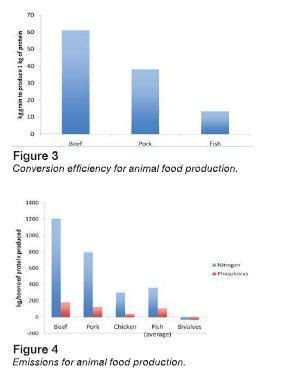
Na continuação da comparação entre diferentes fontes de proteína animal, este relatório analisa os custos da aquacultura. E mais uma vez o peixe de aquacultura surge como a forma mais eficiente de produzir animais para a alimentação humana (comparando com a carne). O relatório explica também que as diferenças do custo ambiental podem ser grandes dependendo da espécie, do país, ou do tipo de aquacultura. Mas no cenário futuro que projectam, em que a aquacultura vai crescer devido sobretudo aos países asiáticos, que têm tradicionalmente o hábito de comer peixe, o relatório tenta dar algumas recomendações para o sector. Um exemplo é melhorar a capacidade de avaliação do custo da aquacultura, com métodos que permitem quantificar os impactes ambientais como o Life Cycle Assessment , permitindo uma comparação mais concreta entre todos os produtos. Fish score well in terms of food conversion efficiencies. They convert a higher percentage of the food they eat into consumable protein. This effi...

Frankenfish - Part II

Depois de terem surgido várias notícias de que o salmão poderia vir a ser o primeiro organismo geneticamente modificado na nossa alimentação...parece que por enquanto o assunto não vai para a frente. Pelo menos no que ser refere à autorização por parte das entidades dos EUA. Aparte de ser um peixe de aquacultura, que como qualquer outro peixe tem custos ambientais associados à sua produção, este peixe é geneticamente modificado. Os seus genes foram alterados e até ao momento não existem estudos suficientes que permitam saber as consequências disto na saúde humana. Para além disso, a produção de um animal como este pode ser um elevado risco para as populações selvagens de salmão e todo o ecossistema associado, sendo praticamente impossível garantir não haverão fugas para o meio envolvente. Last September, details arose about a genetically engineered Atlantic salmon developed by AquaBounty Technologies which had the potential to become the first GM animal product approved for human cons...

The protein puzzle

Image
A proteína é uma das componentes mais importantes da alimentação. Por isso cada vez mais se discute qual a forma mais eficiente de produzir a proteína animal. O tema tem gerado várias discussões devido a dificuldade em avaliar quais os custos ambientais. É difícil de ter uma visão completa dos processos e capacidade de comparar diferentes estudos, e há ainda um elevado desconhecimento sobre alguns impactes em determinados ecossistemas, como o marinho. Há algum tempo que tenho andado à procura de uma resposta para esta questão. E a qui está um relatório que compara a produção e o consumo dos alimentos considerados como a fonte de proteína animal (carne, produtos lacticínios e peixe) na União Europeia. Este post ficou gigante...mas a informação é tão interessante que não consigo resumir mais. O consumo de proteína animal na UE é elevado, como seria de esperar, mas há diferenças significativas no impacte ambiental dependendo no tipo de animal e conforme o tipo de produção. A avaliação d...

The EU market and its consumers are highly complex

According to Paquotte,of the European Commission Markets and Trade section, at EUR 55 billion, the EU is the world’s most valuable seafood market. It represents 12 percent of worldwide seafood consumption but only 5 percent of seafood production , making it by far the No. 1 importer at 9 million metric tons annually, which is twice as much as the United States or Japan. Paquotte explained that a common mistake was often made in assuming that the EU market was homogeneous, when the reality is that it’s disparate. “Firstly, the five largest markets — Spain, France, Italy, the UK and Germany — account for two-thirds of all EU seafood consumed. Secondly, the annual per-capita consumption ranges from 4.5 kilograms in Bulgaria to 65 kilograms in Portugal , with an average of 27 kilograms,” he said. “Consumers eat mostly carp in Hungary, sea bass in Italy, sea bream in Spain, salmon in Germany and the UK, pangasius in Poland and a combination of all these species in France.” Paquotte noted t...
Image
A exploração do atum rabilho é um dos problemas mais actuais e ainda sem solução à vista devido aos preços exurbitantes que cada atum atinge no mercado japonês (um atum pode custar 70 mil €). E há muitas questões à volta do assunto porque grande parte do atum comercializado é ilegal! Porquê ilegal? Porque a pressão é tão grande devido ao lucro obtido, que todos os países do Mediterrâneo encontraram formas de capturar e enviar atuns para o Japão sem cumprirem os limites impostos pelas entidades reguladoras. Este ano a época permitida pela UE para a pesca do atum rabilho foi menos do que um mês. Assim que abriu rapidamente os números das capturas foram atingidos. Há também a questão das jaulas de engorda no Mediterrâneo, que são ilegais porque servem apenas para fazer o peixe engordar e não permitem a sua reprodução e permanência no ecossistema. No meio disto já me perguntava quando é que surgiria a produção controlada ? Faced with dwindling bluefin tuna stocks in the Atlantic and Medite...

Os OGM chegaram ao mar

Image
Food and Drug Administration is holding public hearings next month on the final approvals and labeling requirements for genetically modified farmed salmon by Aquabounty. Most expect that this genetically modified fish, which grows at twice the rate of normal Atlantic salmon, will be available to consumers within 18 months. This will be the first genetically modified animal approved for food consumption , and it has the potential to dramatically change the global farmed salmon market. Em Junho começaram a surgir notícias como por exemplo aqui , aqui e aqui sobre este assunto e agora já se fala na aprovação no EUA. Há algum receio da própria indústria de aquacultura de como é que os consumidores vão reagir. Os argumentos de sempre que justificam a produção de ogm's não são suficientes para uma decisão que pode ter consequências ainda não testadas, tanto na alimentação humana como no ambiente. E o argumento de sempre, de permitir uma maior produção para colmatar a falta de alimentos...